The promise of a tuna performance – and the only performance as part of a month long tuna festival – has brought us to Masuya, down a set of stairs and around the corner of a short hallway of what is otherwise an area almost solely populated by offices that is the city’s business district. It is by sheer luck that Monsieur Poisson and I are even here however, as it was an event unknown to us, and all dinner arrangements were kindly organised by Mr Photographer and his lovely Model T. With the performance scheduled to start at 6pm sharp, we arrive not long after 5:30pm to find a throng of people milling about the doorway having happy snaps taken with one large fish as well as Masuya’s resident sushi chef, Chef Watanabe.

We are shown to our table and find there are waitstaff doing the rounds offering complimentary warmed sake to patrons. There is also a special offer on this evening for a tasting trio of three different 50mL sake shots for only $15 but we pass on this as none of us have a developed appreciation for this Japanese rice wine.

Soon an announcement is made to herald the start of the tuna performance. The place is packed out and we note that there are a lot of Japanese families present. We collectively make our way to the front of the restaurant to gather around the big fish on display beneath a poster with a large kanji character for tuna (鮪). Three ‘tuna handlers’ wearing black t-shirts bearing the same kanji character emblazoned across the back stand en garde alongside the tuna, as well two sushi chefs.

The floor has had plastic sheets laid over it and there are soft, squishy-squeaky noises whenever anyone moves during the opening address by Masuya’s CEO. We’re told the star of the evening is a 69 kilogram, line-caught, wild blue fin tuna which was caught off the coast of Naruma a week previous. It was left to age, much like steak but for a much shorter period of time. With the ring of a bell, the performance officially begins and a short section of the tail is sliced off to expose the fat marbling through the flesh and the CEO explains that this is how buyers inspect daily stock at Tokyo’s famed Tsukiji Market.

With one handler holding down the tail end of the tuna and another holding open a gill flap, the third starts removing the head with a small toothed saw. Next a side fin is removed before the dorsal fin is also cut away, and then a katana-style knife is used to fillet the back of one side of the tuna. This first fillet is then taken on a long chopping board to the awaiting sushi chefs.

The fish is continually wiped down to minimise slippage on the chopping board and, whilst supported at either end again, the belly fillet is removed next followed by the whole backbone. As I stand around dreaming of what type of flavour could be yielded by such a sizeable fish bone, we are told that any small bits of flesh still adherent to the skeleton are removed by scraping with tablespoons and reserved for use in hosomaki and gunkan.

The three tuna handlers get to work with this task as the sushi chefs busy themselves with trimming, removal of skin and separating into small pieces of the fillets. We marvel at the differing shades of tuna flesh and get excited when some distinctly pink toro fillets pass in front of us on their way to the kitchen. There is a full A4 page menu of tuna specials for the month featuring both chutoro and ootoro as well as combination platters of the two.

The head and side fin pieces have been placed in a bamboo basin of ice on display and is a constant attraction for photos throughout the evening, with its open mouth and massive eyes.

We retire to our table and peruse the multiple food and drinks menus before ordering. We suspect there’s a bit of chaos in the kitchen this evening as our dishes come out in an usual order, but more about that later. We start with uni gunkan which are fresh and sweet but a little pricey at $5.50 per piece.

This is immediately followed by the warm dish of ‘Niseko Chicken’ instead of the tuna selection we were expecting. We were hoping to have rice towards the end of our meal with this dish of oven-baked, crumbed thigh fillet in tomato sauce with cheese and a rough potato mash. The tomato sauce is interestingly spiked with basil leaves and I taste something almost anchovy-ish about it as well.

Our tuna nigiri platters arrive next – the one on the left is blue fin tuna while the one on the right is big eye tuna. Each platter is composed of three pieces, one of which is chutoro and one of the fattier ootoro. We order an extra piece of ootoro for each platter (the big eye one was forgotten and brought out separately later) and were surprised to find the big eye variety softer in texture than the blue fin. We were expecting the opposite only because the blue fin platter is more expensive by a few dollars. The other unexpected aspect was that we all found the chutoro more melty in texture than the ootoro, or perhaps it was the pieces we were given which had a bit of sinew in them.

Our waitress tells us she would like to bring out our hotpot next but we remind her we have a couple of cold dishes to go yet. She seems rather insistent about it and we realise later that it is because of a time limit on our table which Model T was not made aware of at the time of booking. In any case, the colourful ‘Rainbow Roll’ arrives which is then followed by the hotpot.

We’ve chosen the ‘Sapporo Hotpot’ which has salmon, blue swimmer crab, scallops, pacific oysters, chicken, fish balls and vegetables in a soy milk and sweet miso paste soup. I’ve never tried this before but have seen it on several travel shows and was excited at the prospect. The oysters come separate to the hotpot itself and our waitress adds them once the soy milk comes to the boil. There is also extra soy milk in a jug on the side should we require it, but the original amount is more than adequate amongst us after the prior food.

The seafood is given a sweet, nutty flavour from the soy milk and the base becomes fresher with the injection of seafood flavours. I’m feeling rather full but keep ladling more of it over my bowl of rice. Partway through the hotpot, however, we are presented with our platter of ‘Sashimi Deluxe’. A impressive selection of scallops, salmon, two types of tuna, bream (?), seared mackerel, scampi and a couple of rice-less avocado hosomaki (rice replaced by tuna!) are served on a bed of ice. A small amount of seaweed salad also decorates the platter and I’m particular amused by the scampi presented sexily draped across an upturned empty oyster shell!

And just when you think there couldn’t possibly be any more food, waitstaff offer diners complimentary tasting spoons of tuna bathed in the tiniest amount of sweet soy. We wonder whether this is some of what was scraped from the tuna skeleton during the performance.

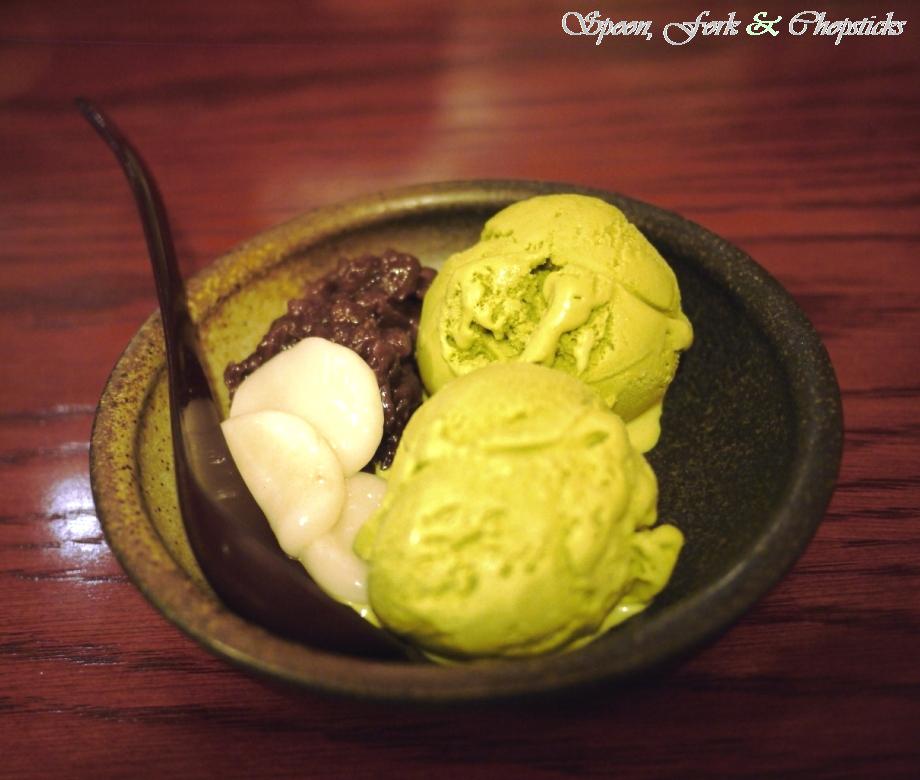
Come dessert time we all want something fairly light so we order a couple of green tea brûlées. Around this time we were presented with our bill although we hadn’t been stopped from ordering dessert itself. So much in their favour, I suppose, desserts were presented quickly and rather quickly consumed by us as well. I’m generally not a fan of brûlées as I have a mild aversion to custard but this had more of a rich mousse-like texture and a lovely matcha flavour. The crackly toffee layer on top was very welcome as well!

Masuya’s tuna festival month is pretty much over but keep your eyes peeled for next year’s tuna festival and performance. I’ve heard it’s something they do annually and it is an experience to see a whole tuna being filleted.
Lower level, 12-14 O’Connell St (near corner Hunter St), Sydney NSW
Tel: (02) 9235 2717, 9231 0038
Opening Hours: Mon-Fri 12pm-2:30pm (lunch)
6pm-10pm (dinner)
Sat 6pm-10pm (dinner only)
Sun CLOSED

happy eating!
PS. Something else that you or may not know about is the NSW Coeliac Society’s Gluten Free Expo being held 6-7 August at Sydney Showground, Sydney Olympic Park. This is a free event in particular interest to those suffering from gluten intolerance or those interested in gluten-free alternative products.