Today
is the final day of the current Chinese year and, whilst the new year doesn’t
officially begin until tomorrow, the Year of Snake is actually already upon us.
From a Chinese zodiac perspective, you’re already in to the following year once
spring has begun and this is why the New Year is also referred to as Spring Festival in Chinese. So all
those people who think they’re just scraping in and giving birth to dragon
babies, well, that boat was missed once 4th February swung around
this year. However it does mean that your baby has arrived perfectly timed to
receive lots of “lei si” red packets!
Showing posts with label Chinese. Show all posts
Chinese New Year 2013
Posted by
Rita (mademoiselle délicieuse)
on
Saturday, February 09, 2013
26
comments ~ Add yours here!
IPot (愛鍋)
When you hear the name IPot, what
sort of imagery does the name elicit? I had thought it was some new-fangled cooking
vessel cashing in on the popularity of one fruit-named company until I came
across this
tweet from Gourmet Forager.
It is more likely a portmanteau of individual + pot, but the “i” also happens
to be a homophone for “ai” – the first character of the restaurant’s name in
Chinese, meaning love, and the name of the place being “love (hot)pot”.
And love hotpot you must, as this
restaurant specialises in the winter warmer that is cooking up stuff in boiling
soup. The novelty is not only in the individual pots, but also the individual
burners built into the table forming a giant induction cooktop surface. Hotpot
ingredients are ordered à la carte, arrive reassuringly fresh and prove to be good value unless you splash out on the wagyu. Soup bases
are charged per pot, and dipping sauces are charged per head but you can help
yourself to as much as you like from a self-serve area at the front of the
store. Various meatballs and dumplings aside, it’s the cuttlefish “noodles”
which are lots of fun – essentially cuttlefish paste in a piping bag which you
get to squeeze into your pot of soup for instant, springy strands of
cuttlefish!
Hong Kong Series: Congee, noodles & rice
There
are many eateries in Hong Kong which sell a combination menu of “jook, fun,
meen, faan” (粥粉麵飯) – congee, (rice-based) noodles,
(wheat-based) noodles and rice. The origins of these were originally, of
course, on
the street – first by trolley vendors, then “dai pai dong” (大牌檔) street-side
stalls and now either in temporary markets or permanent shop spaces.
![]() |
| Congee, steamed plain rice noodle rolls, stir-fried noodles and deep-fried dough sticks |
Posted by
Rita (mademoiselle délicieuse)
on
Saturday, February 25, 2012
28
comments ~ Add yours here!
Hong Kong Series: Street eats & snacks
It
is simultaneously difficult and easy to explain my strong feelings towards Hong
Kong. In one of the most touristy cities in the world, known for its food,
shopping and night life... of food and more shopping, I don't actually play the
tourist. I have family here and, having lived here between the ages of 10 and
14, trips to Hong Kong always feel more like a return trip home rather than a
holiday to explore somewhere. I didn't grow up in Hong Kong, but I grew into
myself there. Each trip is laden with nostalgia and memories of people, places
and, of course, food.
| Trolley street vendor |
Chinese New Year 2012
The imminent Chinese New Year
is said to be an especially good one due to it being a leap year (on the lunar
calendar that means there will be 13 months versus the usual 12), having 2
spring seasons (spring officially begins after the coming new year and also
again prior to the start of the following year), PLUS it will be Year of the Dragon
– a revered mythical figure of power and magic.
![]() |
| Dragon & lion dances in Hong Kong |
Labels:
Chinese
Wontons
When
I was a kid there were much less Chinese eating options in Chinatown, let alone
in the suburbs. Plus the options that were available tended to be more for
dinner dining; you know, ordering various dishes to be shared and eaten with
rice. But what of the more quick lunch options of noodles, congee and the like?
Well, that was not to come for many years which meant that these were often
recreated at home instead.
I
spent a lot of time making wontons with Mum as a child all the way through to
when I left home. It felt like a craft project when I was younger and, although
slow, my little hands and stubby fingers found it easy to pleat neat little
dumpling parcels without tearing the delicate wrappers. (Apparently it was also
a good way to keep me quiet and occupied.) Mum, on the other hand, would be either
short on patience, greedy for greater amounts of filling or both, and ended up
with many exploding wontons instead.
Mum’s
go-to recipe was a beef one and any leftover mince filling was great used
in an omelette. I’ve made a pork version here, with minced prawns, wood ear
fungus and bamboo shoots, which is more reminiscent of the first ones I ever tried
on trips to Hong Kong. Through repeated trips there to visit relatives, I also
discovered that wontons didn’t have to be pleated (although the repetitive
actions to produce neat results appealed to my Virgo nature) and that the
trails of “hanging” wrapper pastry when cooked were meant to make the wontons
resemble fat goldfish. A definite bonus to know they’re meant to look a little
messy, and each a little different, when time and/or patience are a premium. And,
as opposed to Northern Chinese dumplings, wontons are eaten with red vinegar.
The
broth that Mum made for the wontons was always from stock cubes. Time spent on
slow simmering was reserved for Chinese (medicinal) soups instead. I’ve used a
chicken stock paste diluted with water and thrown in some ginger for a more
Chinese flavour, but spring onions or coriander could be added too. Unless
you’re lazy/disorganised like me and realise you have neither until you start
cooking, ahem.
Pork &
Prawn Wontons (makes 60, with some leftover filling)
Ingredients:
· 450g
pork mince (with a small amount of fat)
· 3 tbs light soy sauce
· 1 ½ tbs
dark soy sauce
· pinch of ground white
pepper
· 8
medium prawns, peeled & deveined
· 1
piece of dried wood ear fungus (available from Asian grocers)
· handful of bamboo shoot
slices (available from Asian grocers in cans)
· 1 pack of egg wonton
wrappers (60 sheets)
· 4 tbs chicken stock paste (I used Campbell’s Real Stock Paste)
· 1.5L water, plus extra for
cooking wontons
· ginger slices, spring
onions and coriander to taste
· fresh
or dried egg noodles, Asian greens, red vinegar to serve (optional)
Method:
- Combine pork mince with light soy,
dark soy and a sprinkling of ground white pepper. Mix thoroughly and set
aside to marinate.
- Soak wood ear fungus in a bowl of
water for about 30 minutes, making sure it is completely covered. Drain
and chop into short, thin shreds.
![]() |
| Wood ear fungus - before and after soaking |
- In the meantime, chop bamboo
shoots into similar short, thin shreds.
- Roughly chop prawns until they
resemble a mince and the mixture is slightly sticky.
- Mix pork mince thoroughly with other chopped ingredients. Place approximately 1 teaspoonful of filling mixture in the centre of a wonton wrapper and pinch together to close. Repeat with remaining wrapper sheets until all used.
- Bring 1.5L water to the boil and
dissolve the stock paste into it. Add ginger and any herbs (if using) and
allow to reboil before adding salt to taste. Reduce to a simmer and keep
hot.
- Bring a pot of water to the boil. Drop in wontons in batches and they are cooked when they float to the top and water reboils. Take care not to overcrowd the pot. Remove with a slotted spoon and ladle over hot stock to serve.
Extra
wontons can be frozen flat on a tray or plate and transferred to a freezer bag
once completely frozen. Excess mince filling can be flattened into a shallow
dish, steamed for about 8 minutes on high heat and served with rice - tada, steamed Chinese meatloaf!
happy cooking!
Mademoiselle
Délicieuse received samples of Campbell’s Real Stock Paste courtesy of Nuffnang Australia.
Posted by
Rita (mademoiselle délicieuse)
on
Monday, September 19, 2011
14
comments ~ Add yours here!
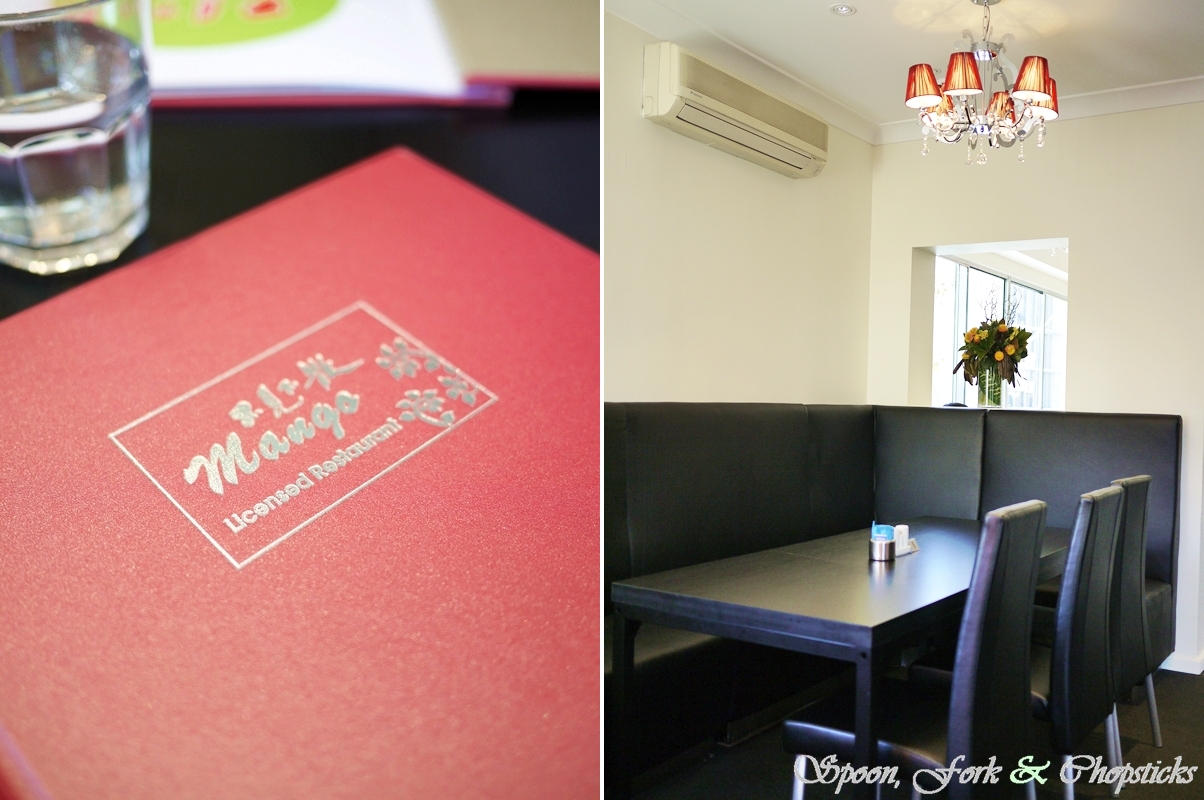
Mango Restaurant (不見不散)
Just like how a song can remind you of a person, an event or a scene from a movie, impressions of food are steeped in the recollections of past experiences and the stories behind them. Understanding why ingredients tend to be used in a particular fashion, where and who you are with when you first try a type of food, cuisine or eatery all combine to influence the future likelihood of you eating similar food or at a similar place again.
For me, Mango Restaurant will forever remind me of the passing of a family member as it was here that I had lunch that day. Scatterbrained due to it being an immediate family member and someone who had lived with us in the past, I decided to eat here as it is a type of food I find familiar. It’s not the type of food we tended to share together but it brought comfort to me in any case. I took my camera along to do something “normal” – well, taking photos of food is normal for food-bloggers in any case – on an otherwise unusual day.
Mango Restaurant is situated in the shop space above Café New York via a dark-coloured staircase entrance on Archer Street. Past the pay counter featuring a pyramid of Carnation milk cans, the interior is light-filled and decked out in contemporary, brown, faux leather furniture no doubt to in attempt to appeal to a young clientele. Its Chinese name has nothing to do with mangoes, nor does the menu. The food is a touch pricier than similar offerings in the area but, for better value, Mango does offer a couple of set meal deals.
I have one of these set deals for lunch where there is a choice of main dish preceded by a soup-of-the-day (cream of chicken on this occasion) with sweet, Asian-style baked bun and rounded off with a Hong Kong-style milk tea to finish. I opt for the comforting ‘Baked spaghetti Bolognese’ which is served in a typical Asian-fusion way with a random mix of vegetables in a sweetened tomato sauce. The tea is smooth and a highlight however, and manages to avoid leaving a chalky feeling around the teeth like so many others.
Monsieur Poisson decides to order the seafood soup mainly for its puff pastry lid, which arrives gloriously domed and holding the contents of a tomato-based broth. This is followed by the ‘Baked Portuguese chicken rice’ which has doubtful Portuguese origins, but does have a most fragrant sauce of coconut milk and curry powder.
Despite many years of living together this family member and I were not close emotionally and only ever close in proximity. I acknowledged their quirks, frustrating as they were, but was essentially too different in personality, upbringing and outlook to find anything common over which to bond. There is a strange sense of being unsure of what it is exactly that you’ve lost in such a case, apart from the mourning of a relationship and possibilities which could have been. And I’m very sad to say there are no standout shared food memories to look back fondly on either.
Mango Restaurant (不見不散)
Level 1, 77 Archer St, Chatswood NSW
Tel: (02) 9419 6591
Opening Hours: 7 days..11am-9:30pm?
*EDIT*: As at October 2012, Mango Restaurant is closed for business.
happy eating!
What’s in a wok?
Chinese home kitchens typically aren’t heavy with gadgetry. You will normally find a sizeable round chopping block, an all purpose meat cleaver, a fruit/paring knife and, at the centre of it all, a wok. A wok which preferably comes with a lid.
Woks can be used for essentially every type of Chinese cooking method – stir-frying, pan-frying, deep-frying, boiling, stewing, braising, steaming, smoking (the latter two are when the lid comes in handy) – hence their importance in the kitchen. As a result, the desirable features of a wok include even heating and having steep and deep sides to prevent spillage when cooking, as well as for practical spacing issues on the stove.
In a space-tight city such as Hong Kong, it is common for home kitchens to have two-burner gas stoves which sit atop a section of purposely low kitchen benchtop. The wok lives permanently on one of the burners because why would you need to put it away when you’re using it every day? And although I have a four-burner cooktop in my current kitchen, I still need to be mindful of large woks which can effectively invade the space of other burners despite it being positioned on only one of them!
My maternal grandfather had a small wok which was coveted by all family members. It heated up quickly and was relatively light, and had become blackened through being well-seasoned over many years of use which rendered it non-stick. It was narrow in diameter and had a rounded bottom which fit perfectly into the stove burners. This was inherited by an aunt of mine but sadly it had to be retired a couple of years ago.
Modern woks, such as the Anolon one pictured above, conveniently come with a non-stick coating which does away with the seasoning process and means little or no oil needs to be used when cooking. Well, unless you’re deep-frying, of course! They also tend to have a wider flat area at the bottom compared with traditional woks, which means you can still fry “flat” things (like eggs, crêpes, pancakes, etc) without everything pooling in a pit. At 30cm in diameter the Anolon wok is at the upper extremity of my ideal size, only because I have small hands and wrists and have trouble balancing anything larger, although the rubber-coated handle which is ingeniously taller than it is wide aids with its grip.
And grip is important when cooking things such as the stir-fry below, so that you can slide it out onto a plate when done rather than having to lift it out in sections and lose heat from your cooked dish.
Stir-fried bitter melon with egg (涼瓜炒蛋) (serves 2-3 as part of a meal)
Bitter melon is something I didn’t learn to appreciate until a few years spent living in Hong Kong. It was rarely available in Sydney during my childhood, although thankfully this is not the case now. Cantonese cuisine features melons/gourds from summer through to autumn, whilst the colder months are spent eating green leafy vegetables. Blanching the melon slices prior to cooking helps to temper the bitterness, and cooking it with egg adds a creamy sweetness.
Ingredients:
· 1 medium-sized bitter melon
· 2-3 eggs, lightly beaten
· small chopped chilli, XO sauce (optional)
Method:
1. Halve the bitter melon lengthwise and remove the seeds and soft inner pith by scraping with a teaspoon. Cut the melon into thin (3-4mm) slices.
2. Heat a wok over medium-high heat and add the bitter melon. Pour enough freshly boiled water over to cover the melon slices. Add 1 tsp salt and stir until dissolved. Once the bitter melon slices take on a bright green colour, strain and set aside. Discard the cooking water.
3. Return the wok to the heat and wipe dry the inside with a paper towel. Return bitter melon to the wok and stir-fry briefly with ½ tsp salt. (Chopped chilli and XO sauce, if using, can be added to the melon at this point in time.) Pour over the egg and let cook until starting to set before turning over, in sections – it does not have to be neat or kept in one piece like an omelette. Continue to flip and turn until the egg is cooked then slide onto a plate to serve.
Mademoiselle Délicieuse received an Anolon Advanced 30cm Open Stir-Fry pan for review courtesy of Kitchenware Direct as part of this post.
happy cooking!
Labels:
Chinese,
recipe,
stir-fry,
vegetarian
Chinese New Year 2011
Growing up many years ago in Sydney, Chinese New Year had very little impact on me as there were hardly any festivities about, plus all the family we have lived overseas. Mother had drummed the cultural importance of it into me but, with it being as much a celebration of family union as it is the new (northern hemisphere) spring season as well as the new year, well, it was somewhat lacking in atmosphere and excitement which made it hard to appreciate the significance.
Then we spent it in Hong Kong one year when I was around the age of 7. It was a complete revelation – celebratory foods which I had never seen, smelt or tasted graced storefronts and markets in colourful packaging which could be purchased by the pound. Hong Kong is a place steeped in Chinese culture with Western influences and relics of British colonial rule; pre-packaged goods appear in metric units, but fresh goods at markets or older style grocery stores are still purchased by the pound or by the “gun” (斤) which is equivalent to around 600 grams.
The days leading up to the new year saw a flurry of activity I had never witnessed beyond my own household – cleaning the home, having hair cut and buying new clothes all to welcome the new year and a fresh start in the best possible way. There is also the practical reason of making sure your home and its people are presentable for receiving visitors during the new year period. We either had family visiting us or we ourselves were off to various relatives’ places which made it seem like a party which stretched on for several days. For the very first time, I laid eyes on a “chuen hup” (全盒) – a Chinese candy box used to present sweets to guests who visit your home during Chinese New Year. Us kids, of course, looked forward not to the traditional Chinese sweets such as dried and sugared coconut and winter melon or lotus seeds, but rather the inclusions of chocolates and fruit lollies. And now, with Monsieur Poisson and I married and with our own home, a Chinese candy box is one of things I’d like to add to our household inventory.
That trip also marked the first time where I was surrounded by family on the eve of Chinese New Year for “tuen nin fahn” (團年飯) – a family reunion dinner where togetherness, completeness and abundance are celebrated. Our dinner this year was held at Fook Yuen (馥苑) with the feast officially beginning when ‘Ginger and spring onion crab on a bed of e-fu noodles’ (薑蔥蟹伊麵底) is brought to the table; its lengthy noodles symbolising longevity. A whole steamed parrot fish with ginger and spring onions soon follows and the head is offered to my mother-in-law out of respect as she is most senior at our table. Fish cheeks happen to be prized as there is so little of it per fish and are incredibly smooth in texture.
‘Crispy skin chicken’ is a favourite of my mother-in-law’s, and especially on occasions like this as chickens mean eggs and eggs mean further chickens – it’s all about offspring and the continuation of family in Chinese terms. The water spinach stir-fried with chilli and fermented bean curd (椒絲腐乳通菜) is much less symbolic and purely for the purposes of us needing some vegetables as part of the meal!
A dish which has graced our family dinners in recent times is deep-fried milk (炸鮮奶) – cubes of milk with eggwhite coated in batter and deep-fried. A plateful of these are usually served with white sugar for dipping but, on this occasion, acts as a side to stir-fried prawns. Not Cantonese in origin and not found on menus all that often, I urge you to try it if you come across it.
An eggplant hotpot offers more vegetable relief (aubergine!) as do stir-fried garlic shoots with wood ear fungus and pork strips. “Hoi tong tofu” (海棠豆腐) is a textural delight with a steamed soybean milk and eggwhite base topped with a jumble of prawns, dried shiitake mushrooms, pork and sliced Chinese broccoli ‘gai larn’ stems.
Complimentary red bean soup (紅豆沙) rounds off our meal along with a fruit platter (unpictured), as well as the new year’s addition of deep-fried sesame balls (笑口棗). Crispy on the outside, they have a bready-biscuity centre and their burst open appearance are said to resemble smiling mouths.
This year heralded the introduction of a few new year traditions to the Délicieuse/Poisson household. The first involved buying a Chinese new year’s cake “nin go/nian gao” (年糕) as it’s something my mother has always done. The second was the making of peanut cookies, but I’m afraid the deep-fried glutinous rice balls (below) were store-bought. The third involved a vegetarian meal on the first day of the new year – something which is done to appease the gods and also to cleanse the body following heavy eating on the eve of the new year, as well as prior to the feasting which follows.
Hairy melon/gourd (節瓜) which had been scraped of seeds and poached in stock were topped with stir-fried vegetables and wood ear fungus. The poaching liquid then became the base for a light soup with tofu, ‘choy sum’ and konjac/konnyaku jelly threads.
Regardless of whether the meal appeased the gods or not, hopefully it will become a part of our own yearly ritual and something that can be passed onto our future children to deepen their understanding of Chinese New Year.
Fook Yuen (馥苑)
Level 1, 7 Help St, Chatswood NSW
Tel: (02) 9413 2688
Opening Hours: 7 days around 10am-3pm (yum cha lunch)
around 5pm-11pm (dinner)
happy chinese new year & happy eating!
Posted by
Rita (mademoiselle délicieuse)
on
Thursday, February 10, 2011
12
comments ~ Add yours here!
Labels:
Chinese
Food to nurse hangovers
It’s hot and stuffy. The sun is blazing outside and rudely creeping in through the blinds. Oh, my eyes! Why is it so bright? You move to roll over. Whoa…the bed, or wherever you parked yourself last night/this morning, feels like a tiny dinghy bobbing about on rough seas. *Bob, bob, bob, bob…* It’s too hot to keep sleeping and you really need something to settle down the party which has been continuing in your stomach and bloodstream despite you stopping hours ago.
Good morning (or afternoon), and a happy new year to you, your stomach, your pounding headache and…so nice of you to join us, Hangover!
Although there are no foods which can miraculously cure hangovers, there are certain foods that somehow make you feel better through nothing other than comfort or placebo effect. If you’re wanting something fast-food yet can’t bear the usual international chains, then Ocean Foods has many deep-fried and more virtuous non-deep fried options. The grilled barramundi with chips (below) is just one of them – it is unbattered and cooked on the spot like all their hot foods. Paired with some sweet, crunchy and not-at-all greasy crab claws as well as a small tub of salad (coleslaw in this instance, pictured below) and you can soothe that hangover whilst having a balanced meal. For something in a more central location, there’s that famous soft-shell crab omelette (unpictured) from Café Ish which the husband keeps raving to everyone about.
Or perhaps you want something a little more pure and soothing. Pho An has any combination of beef, fatty beef, beef meatballs, beef tendon, tripe, chicken, etc in a fragrant Vietnamese beef or chicken broth with slippery flat rice noodles where chewing isn’t even required. Topped with fresh herbs to awaken the senses, stir in chopped chillies for warmth and slurp to restore some much-needed hydration. Noodle bowls are available in small (regular) and large sizes, and your food will appear almost instantly by magic. Peruse the menu at the doorway or ask for a printed menu when seated, as the wall menus are in Vietnamese and Chinese only.
To combine the best of both worlds Ton Ton Regent has ramen, karaage chicken, gyoza and tempura amongst other things, whilst Menya Mappen has udon, soba, lots of fresh crunchy tempura and kakiage, poached egg and small rice bowls all for very affordable prices. And runny eggs always make things better.
Gumshara will give you a thick, sticky, flavoursome and soul-restoring soup where each bowl is taste-tested by the master himself before being served. The noodles are springy and the pork is plentiful. Add a soft-boiled egg and you’re absolutely set for the day. If you want an alternate to noodles the ‘Special Rice’ bowl is serious value at around $8 with a foundation of rice mixed with sesame seeds, soft-boiled egg and vegetables topped with roast pork, and then the whole thing repeated on top of it again – it will satisfy the most ravenous of hangover hungers.
For a variety of eats including deep-fried things, rice, noodles, soups and Hong Kong fusion-style pastas then you simply cannot go past a “cha chaan teng” (茶餐廳). Iced lemon tea rates highly on my long-time loves even though it’s only black tea, sugar syrup and fresh lemon slices. You’ll find sweet drinks incorporating azuki (red) beans and grass jelly as well as Hong Kong-style French toast “sai dor see” (西多士) – typically two slices of white bread sandwiched with peanut butter, deep-fried in eggy batter before being served with butter and golden syrup. Trolley/cart noodles used to be street food sold, well, from a mobile cooking trolley, allowing for personalisation of soup noodles (flat rice noodles, rice vermicelli, Hokkien noodles, flat egg noodles, thin egg noodles, etc) and toppings (dried squid, fish balls, fried fish skin, luncheon meat, ham, pig’s blood jelly, beef meatballs, pork meatballs, chicken wings, mushrooms, etc and an array of vegetables). Not available at many Hong Kong fusion-style cafés in Sydney, Victoria Noodle Restaurant offers a great selection of noodles and toppings as well as other menu items. Try their salt and chilli chicken wings with rice – hangover or no hangover – if you get a chance.
For something healthy and sweet, wowcow serves 98% fat-free yoghurt with active cultures that is smooth and slides easily down the throat. One of Sydney’s earlier frozen yoghurt chains, mix in whatever toppings take your fancy from their display window and pair with cinnamon-sugared wow-sticks (baked churros) for dipping. I spotted Joh Bailey bringing a group of friends here late one night, and don’t forget to crane your head back (provided it doesn't induce too much dizziness) to marvel at the cow feature adorning the ceiling!
Corner of Lyons Rd & Gipps St, Drummoyne NSW
Tel: (02) 9181 4336
Opening Hours: 7 days 9am-9pm
82 Campbell St (cnr Foster St), Surry Hills NSW
Tel: (02) 9281 1688
Opening Hours: Mon-Tues 7am-4pm
Wed-Fri 7am-10pm
Sat 9am-10pm
Sun 9am-2:30pm
Pho An
27 Greenfield Pde (near cnr Stewart Ln), Bankstown NSW
Tel: (02) 9796 7826
Opening Hours: 7 days 7am-9pm
Shop 10.16, Ground floor of Regent Place, 501 George St (cnr Bathurst St), Sydney NSW
Tel: (02) 9267 1313
Opening Hours: 7 days 11:30am-10pm
Shop 11, Ground Floor of Meriton Tower – Skyview Shopping Plaza, 537-551 George St (near cnr Liverpool St), Sydney NSW
Tel: (02) 9283 5525
Opening Hours: Sun-Wed 11:30am-10pm
Thurs-Sat 11:30am-10:30pm
Gumshara
Shop 209, Lower Ground Level, Harbour Plaza, 25-29 Dixon St (Chinatown), Haymarket NSW
Tel: 0410 253 180
Opening Hours: Mon CLOSED
Tues-Sun 10am-10pm
Shop A8, Lower level of Victoria Plaza, 369 Victoria Ave, Chatswood NSW
Tel: (02) 9410 1822
Opening Hours: 7 days…11am-10pm
Shop 2, 304-308 Victoria St, Darlinghurst NSW
Tel: (02) 9326 0400
Opening Hours: Mon-Thurs 11:30am-11pm
Fri 11:30am-12 midnight
Sat 11am-12 midnight
Sun 11am-11pm
happy eating!
Mid-Autumn Festival (中秋節), 22 Sept 2010
After Chinese New Year, the next biggest cultural event for the Chinese would have to be Mid-Autumn Festival (中秋節) falling on the 15th day of the eighth month on the lunar calendar. The 15th of each calendar month is always a full moon, hence some calendar years will have 12 months while every now and again there is a ‘leap year’ with 13 months. The eighth month which falls in the middle of autumn for those in the northern hemisphere and, in a time when most people farmed for a living, signals the end of harvest season. The festival celebrates hopefully a plentiful harvest with excess fresh food preserved, dried or pickled to last through the colder months of the year.
The full moon during this month is said to be at its largest and roundest, which signifies completeness and togetherness, and is as good a reason as any for a family gathering. Dinner is followed by the sharing of mooncakes, pastries made traditionally in carved wooden moulds with a chewy pastry shell enclosing a filling most commonly of lotus seed paste and a salted duck egg yolk or yolks. A seemingly strange combination, the contrast of the smooth, sweet and thick lotus seed paste is quite enjoyable against the slightly salty, almost grainy texture of the duck egg yolk.
Mooncakes are not cheap due to the labour involved in making the lotus seed paste – getting the colour and taste right is an artform, as is achieving an evenly thin pastry skin to hold together its contents. I bought a mini mooncake for the husband and myself this year as they are quite rich and we don’t crave them as much as when we were children. There are many locally-produced brands as well as a broad range of imported ones these days. The packaging rarely changes for easier recognition, although generally come in tins as opposed to cardboard boxes like during my mother’s childhood. The ones pictured just happen to be one of the brands I grew up with.
I lived for a few years in Hong Kong when I was a teenager and thoroughly enjoyed celebrating Mid-Autumn Festival there, as I did other Chinese festivals. Mid-Autumn Festival meant stationery and toy stores would have elaborate displays of paper lanterns for purchase as well as, at the time, new-fangled electric versions – these are basically a torch with a toy-shaped cover. Fruit stores would be full of pomelos and starfruit, both in season at this time of year north of the equator. Dinner and mooncakes were followed by a trip to a nearby park to play with pre-purchased paper lanterns. They are lit up by small candles held in place by a small metal clasp within the lantern on the base. This was the only time when we were allowed to play with fire – albeit under adult supervision, of course – and the lanterns would invariably end up catching alight meaning it was time to go home.
Last night we had dinner out with our mothers, Monsieur Poisson’s cousins and a cousin of mine who is back visiting Sydney for the first time since he graduated from university and returned to Hong Kong. We had lobster, crispy chicken, whole steamed barramundi and deep-fried milk amongst other things but the food was actually not the focus for me. This food blogger took a night off from photographing what was being eaten for once – this is a bittersweet time of year for me so I am most grateful to have the company of family around.
Strangely, Monsieur Poisson decided to take photos on his phone instead!
happy mid-autumn festival & happy eating!
Posted by
Rita (mademoiselle délicieuse)
on
Thursday, September 23, 2010
12
comments ~ Add yours here!
Labels:
Chinese
Subscribe to:
Posts (Atom)